
Quartz Countertop Slab Sizes: A Guide to Thickness and Waste
You’ve measured your kitchen, chosen the material and received a quote. Then the fabricator says, “You’ll need two slabs,” and the budget changes. Often, it’s the way the pieces fit on the slab that makes the difference, even when the total square footage looks right. Slab sizes, thickness and fabrication waste may seem straightforward in isolation. Together, they determine your countertop’s cost, appearance and project timeline. This guide explains where to confirm slab dimensions, how to choose a thickness and how to calculate waste step by step.
Short answer: Quartz slabs are typically around 3 meters long and 1.5–1.6 meters wide, with slabs sold as jumbo toward the upper end of that range. The thicknesses most often discussed for countertops are 1.5 cm, 2 cm and 3 cm. Exact specifications vary by manufacturer, series and production technology.
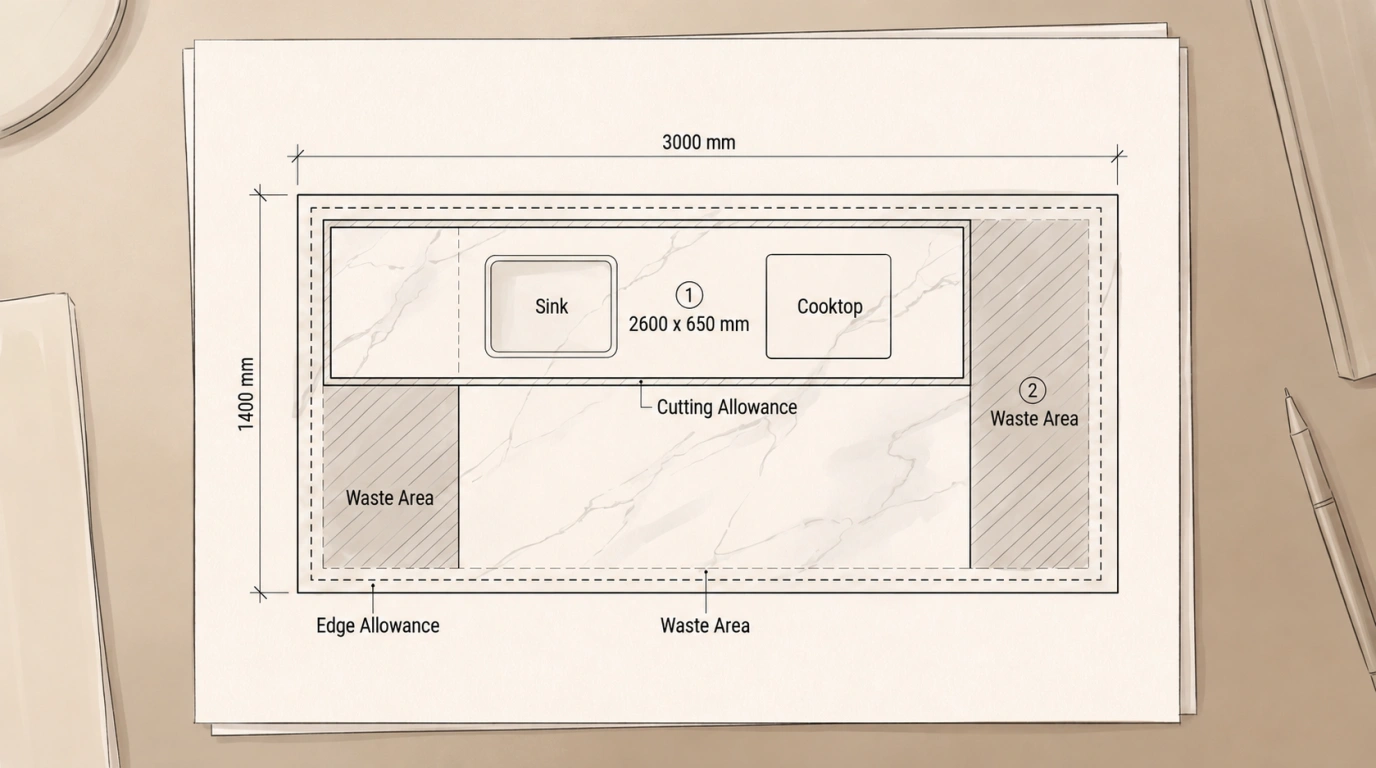
Why Do Quartz Countertop Slab Sizes Vary?
Quoting one size for all quartz slabs is a common mistake in both search results and showrooms. Slabs in the same category can have different dimensions depending on the manufacturer, collection and production technology.
Standard and Jumbo Slabs
“Jumbo” is widely used in the industry but has no official standard. A size one manufacturer calls standard may match another’s jumbo slab. To get a clear picture, ask “What are the slab’s actual length and width?” A large slab may reduce the number of seams on a long countertop where you want an uninterrupted surface. You can confirm that advantage only by checking the cutting layout.
Where Can You Verify Slab Dimensions?
Compare measurements from three sources:
The manufacturer’s product and technical specification pages
The slab size on the dealer’s or fabricator’s written quote
Measurements taken directly from the slab
If the three sources disagree, ask for written confirmation before calculating waste. You’ll find current Coante product information on the technical specifications and physical properties pages. For an overview of the series and colors, see Coante countertop models: a guide to series and colors.
Choosing a Thickness: 2 cm, 3 cm or a Thin Profile?
In Türkiye, 1.5 cm and 2 cm are the most popular thicknesses for quartz countertops. In markets such as the United States, 3 cm is the best seller. Thickness affects appearance, the support structure, edge fabrication and weight.
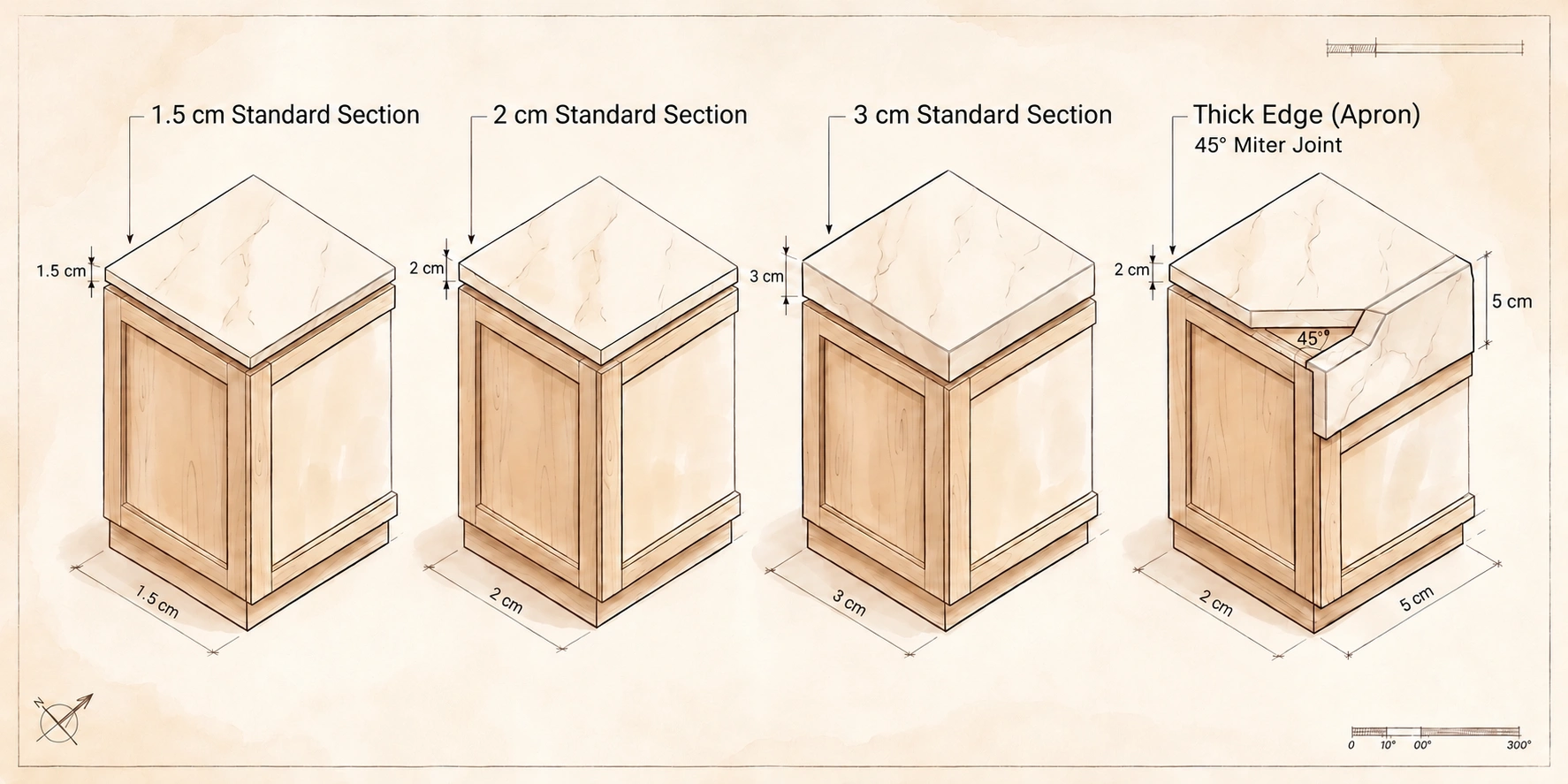
How Thickness Affects Appearance
A thick edge gives a countertop a substantial, distinctive look, while a thin profile creates a lighter, more contemporary line. If you want a 2 cm slab to look thicker, the fabricator can add a strip along the edge to create a built-up edge, or apron. An edge can also be shaped to look slim regardless of the slab thickness. Ask whether the thickness on your quote refers to the slab itself or the visible edge.
Thickness and Structural Support
Thinner slabs are more sensitive to the construction of the base cabinets and the spacing between supports. The support needed for island overhangs, areas around sink and cooktop cutouts, and other projecting sections depends on the thickness, product and project. Consult the fabricator and the manufacturer’s technical documentation for support recommendations specific to your installation. To understand what durability to expect, see Do quartz countertops scratch? Stain and heat resistance.
When Does a Thin Profile Make Sense?
Thin profiles work particularly well for wall cladding, bathroom surfaces and projects that call for a light appearance. When used for a countertop, a thin slab generally needs an even, continuous base. When deciding, ask, “Will this surface carry a load, or will it serve mainly as a decorative covering?”
Material Loss at Cooktop Cutouts, Sink Cutouts and Seams
Cooktop and sink cutouts remove material from the middle of a slab. The offcut is often too small to reuse elsewhere. The inside corners of these openings should be rounded, since sharp corners can develop cracks over time. Seams also require precise, careful work.
Planning Seams for Wide Kitchen Countertops and Islands
For a wide kitchen countertop, the first decision is whether to use a single piece or to join sections. Slab size, the ability to transport the piece and the direction of the veining all influence that decision.
When Does a Jumbo Slab Make Sense?
A large slab can reduce the number of seams along a long run of wall cabinets, on a wide island or wherever the design calls for inconspicuous joints. Larger slabs are harder to transport, however, and require extra care to manage the risk of breakage. Choose a large format when its advantages suit the project.
Where Should the Seam Go?
Keep the following points in mind when planning seam locations:
Keep seams away from the immediate vicinity of cooktop and sink cutouts. Ask the fabricator what they recommend for these areas.
Where possible, place the seam at a natural break in the pattern or somewhere it is less likely to catch the eye.
On veined surfaces, cut adjoining pieces from adjacent areas of the same slab so the veining appears to continue across the seam.
When Should You Measure and Make a Template?
Take measurements once the base cabinets are fixed in place and the cooktop and sink models are confirmed. A change in appliance dimensions means redrawing the cutouts and recalculating waste. Confirm appliance and fixture models in writing before measuring to reduce the risk of costly changes after cutting.
Frequently Asked Questions About Quartz Countertop Dimensions
How Thick Is a Quartz Countertop Slab in Centimeters?
In Türkiye, the most common thicknesses are 1.5 cm and 2 cm, while 3 cm is more popular in the United States. Thickness can vary by series and production technology, so check the manufacturer’s technical specifications for the exact figure.
What Are the Dimensions of a Quartz Slab?
There is no single standard size. Most slabs are around 3 meters long and 1.5–1.6 meters wide, with jumbo slabs at the upper end of that range. Before buying, confirm the actual dimensions of your chosen series in writing.
The Next Step: Plan Your Project on the Slab
No single table covers every quartz countertop slab size. Planning dimensions, thickness and waste together helps you control your budget and achieve the look you want. Make a list of the pieces you need, confirm the slab dimensions in writing and review the cutting layout before you order. Coante uses three different quartz production technologies at the same site. To explore thicknesses and formats in its collections, find your nearest dealer through the sales network or contact the Coante team with technical questions.